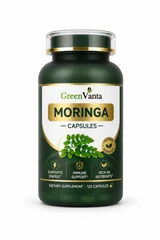
The dose math nobody shows you
A level teaspoon of moringa powder weighs about 2 grams. A standard leaf capsule holds 500 mg. So:
- 1 teaspoon of powder ≈ 4 capsules’ worth of leaf
- A typical capsule serving (2 capsules) = 1,000 mg ≈ half a teaspoon
- A smoothie habit of 1–2 teaspoons a day delivers more leaf than a 2-capsule routine
If you want the most leaf per day and enjoy smoothies, powder gives you more to work with. If you want a guaranteed daily amount with zero friction, capsules win, because the best dose is the one you don’t skip. US research on leaf powder found that GI symptoms became more frequent at high doses (above about 7 g/day), so more is not automatically better (PMC11986971).
Powder vs. capsules, factor by factor
| Factor | Powder | Capsules |
|---|---|---|
| What’s inside | Dried, ground moringa leaf | The same leaf powder in a shell |
| Typical serving | 1–2 tsp (≈2–4 g) | 2 capsules (≈1 g) |
| Taste | Earthy, slightly bitter | None |
| Prep | Blender, mixing, cleanup | Glass of water, 10 seconds |
| Cost per gram | Lower | Higher |
| Portability | Messy to travel with | Pocket-friendly |
| Dose accuracy | Depends on your spoon | Pre-measured |
Taste
Powder tastes like a concentrated green leaf, a bit like strong matcha crossed with spinach. Capsules taste like nothing, which for most people is the whole point.
Convenience
Powder asks for a blender, a recipe and a cleanup every day. Capsules ask for a glass of water. On busy mornings and travel days, that difference decides whether the habit survives.
Cost
Per gram of leaf, powder usually wins. You’re not paying anyone to fill capsules. The real question is whether the savings beat how often the powder sits unused in your kitchen. Check current prices on Amazon and divide by grams of leaf to compare fairly.
Who should pick which
Choose powder if…
- You make smoothies or cook with greens most days anyway
- You want the lowest cost per gram and flexible, larger servings
- You don’t mind an earthy taste
Choose capsules if…
- You’ve quit greens powders before because of taste or effort
- You travel, commute, or want a routine that survives busy mornings
- You want the same measured amount every day
Our verdict
Powder is the better value; capsules are the better habit. For capsule buyers, we suggest a bottle that keeps the format simple: pure leaf, a real two-month supply, and a clear label. See our best moringa capsules comparison for options, including organic alternatives.
Frequently asked questions
Are moringa capsules as effective as moringa powder?
Capsules contain the same dried leaf powder, so gram for gram there is no meaningful difference. The practical difference is dose: a teaspoon of powder holds more leaf than a couple of capsules.
How many moringa capsules equal one teaspoon of powder?
A level teaspoon of moringa powder weighs roughly 2 grams. A standard capsule holds 500 mg, so a teaspoon is about 4 capsules' worth of leaf. A 2-capsule serving (1,000 mg) is about half a teaspoon.
Which is cheaper, moringa powder or capsules?
Usually powder, per gram, because filling and bottling capsules costs money. Compare the cost per gram of leaf, not the cost per container.
Does moringa powder taste bad?
It tastes like a concentrated green leaf: earthy and slightly bitter. Some people enjoy it in smoothies; others abandon the bag. Capsules remove the taste entirely.
Can I open moringa capsules into a smoothie?
Yes. The capsule is just a container, though loose powder is the cheaper way to buy the same leaf for that use.
Sources
These statements have not been evaluated by the Food and Drug Administration. This product is not intended to diagnose, treat, cure or prevent any disease. Talk to your healthcare provider before starting any supplement, especially if you are pregnant, nursing or take medication. See our medical disclaimer.